Builder: Standard Steel Car Company (SSC) for New York Central Railroad
Year Built: ~1928-1929
Type: Heavyweight steel MU commuter coach / trailer car
Original Number: New York Central 4332 (related to 4331 series)
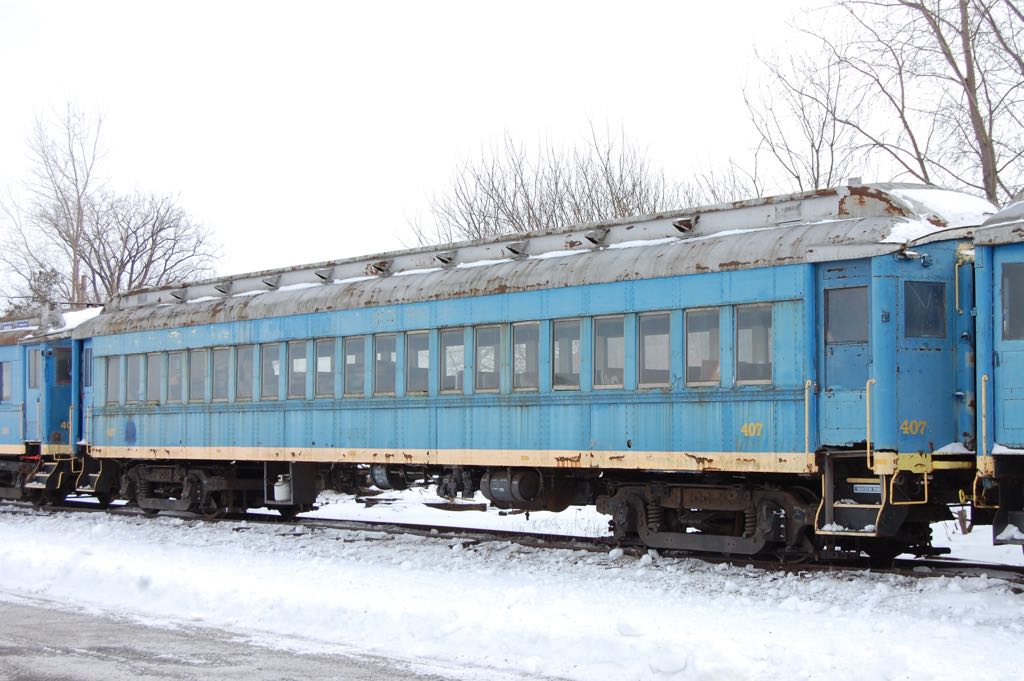
TLE&W Coach 407 (ex-Penn Central 1292, ex-New York Central 4332 / related to 4331 series, built ~1928-1929) is a preserved heavyweight multiple-unit (MU) trailer coach at the Toledo, Lake Erie & Western Railway and Museum. It is one of a small number of surviving examples of New York Central’s early 20th-century electric commuter coaches.
Construction and Early Years (~1928-1929)
The coach we now cherish as TLE&W 407 was built around 1928-1929 by the Standard Steel Car Company for the New York Central as part of groups like Lot #2110 (cars such as #4327-#4336) or related lots. It was one of a large series of all-steel, heavyweight multiple-unit (MU) commuter coaches constructed for high-frequency suburban service. These cars represented an important advancement in durable, efficient passenger equipment designed specifically for electrified operations, with features like steel underframes and bodies for strength in daily stop-and-start service.
Service on the New York Central (~1928/1929–1968)
Assigned to the New York Central’s electrified suburban and commuter lines (such as those radiating from Grand Central Terminal in New York City), ~4332/related car 407 served as a daily workhorse for four decades. It operated on short-haul routes carrying commuters to and from the metropolitan area’s suburbs. These were practical, high-frequency services focused on reliability and capacity rather than long-distance luxury.
Originally configured with upholstered seats in a high-density layout (e.g., 3-and-2 or similar, often 78-100 seats), the car offered functional comfort for its era. Passengers experienced a sturdy, no-frills atmosphere: large windows providing views of the passing urban and suburban scenery, electric lighting, and ventilation appropriate for daily use. During peak hours, the coach filled with businessmen reading newspapers, office workers, and everyday travelers. Smoking was generally permitted (often throughout the car or in designated sections until later restrictions), creating the typical hazy yet sociable vibe common to mid-20th-century commuter trains. The ride was smooth thanks to the steel construction and MU design, with the steady rhythm of electric motors (from powered units in the consist) and rail joints accompanying the daily commute. No historically significant individuals are documented as having ridden this specific car—it was one of many identical coaches serving the general public rather than a reserved parlor or sleeper.
Penn Central Era (1968–~1972)
Following the 1968 merger that formed Penn Central, the car was renumbered PC 1292 and continued in commuter service. It remained part of the fleet of ex-NYC MU coaches (renumbered into the 1250-1296 range) until Penn Central’s financial challenges led to the retirement of older equipment around 1972.
Acquisition and Preservation by the Toledo, Lake Erie & Western Railway and Museum (early 1970s–Present)
In the early 1970s, we acquired the car (then PC 1292) and renumbered it 407 to join our growing collection of historic rolling stock. Along with its sister car 408 (ex-PC 1276 / ex-NYC ~4315), it became a key asset in our efforts to preserve examples of early 20th-century steel commuter coaches. From our perspective as its current stewards, bringing 407 into the collection has allowed us to safeguard a tangible piece of the golden age of rail commuting and the engineering progress of the late 1920s. We have maintained and operated it on our excursions (and for community events), enabling visitors to experience living history on our line. Over the decades, it has proven to be a reliable coach for tourist trains, offering passengers a step back in time while demonstrating the longevity of these well-built cars. Only a small number of cars from this production run survive today (with just a few known to exist, two of which are in our care at TLE&W), making 407 a rare and valuable piece of railroad heritage that we are proud to protect and share.
Technical Specifications
| Attribute | Details |
|---|---|
| Builder | Standard Steel Car Company (SSC) for New York Central Railroad |
| Year Built | ~1928-1929 |
| Type | Heavyweight steel MU commuter coach / trailer car (originally equipped for electric multiple-unit operation; now operated as a conventional coach) |
| Original Number | New York Central ~4332 (related to 4331 series, Lot #2110 and similar) |
| Later Number | Penn Central 1292 |
| Current Number | Toledo, Lake Erie & Western 407 |
| Construction | All-steel body, heavyweight construction with railroad roof |
| Seating | Upholstered seats in high-capacity commuter configuration (typically 78–100 seats, often 3-and-2 arrangement) |
| Dimensions (approx., class typical) | Length: 69’3″; Width: ~9’11”; Height: ~13’10”; Weight: ~130,800 lbs |
| Original Equipment | Equipped for MU electric operation; double-ended (DE) design; compatible with GE motors/controls in consists (e.g., ~380 hp per powered unit); air brakes |
| Service History | New York Central electrified suburban/commuter service (~1928/1929–1968); continued under Penn Central until ~1972 |
Collection Details
Preserved in the Toledo, Lake Erie & Western Railway and Museum outdoor collection
Accession: 1972.2.1 | Acquired: 1972 | Status: On Display