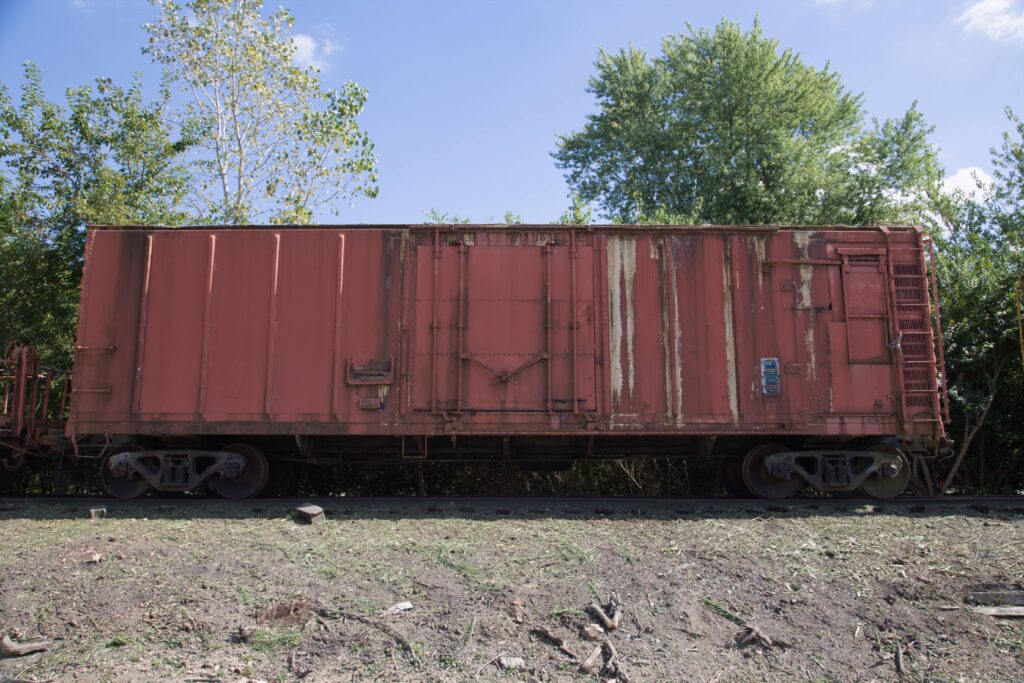
HFPX 135 (Hygrade Food Products), 1961
Builder: General American Transportation Corporation (GATX) (conversion from Pacific Fruit Express R-40-23)
Type: Mechanical refrigerator car (all-steel construction); repurposed as non-revenue tool car
Classification: Revenue freight car (AAR Type RPM, mechanical reefer; now AAR Type M930 non-revenue)
Original Use: Transporting perishable meat products for Hygrade Food Products Corporation.
Build and Early Service
The HFPX 135 originated as part of the Pacific Fruit Express (PFE) R-40-23 class, a series of 40-foot all-steel ice-cooled refrigerator cars built in 1947 by the General American Transportation Corporation (GATX) for PFE, a joint venture between Southern Pacific and Union Pacific railroads. These cars, numbered in the PFE 47203-47702 series, were designed for transporting perishable produce like fruits and vegetables from West Coast growing regions to markets nationwide. Key features included improved Dreadnaught ends for structural integrity, Murphy steel roofs, and insulation to maintain ice-cooled temperatures during transit. The class represented a post-World War II advancement in reefer design, incorporating high-strength steel and enhanced ventilation to reduce spoilage. In 1961, amid the industry’s shift to mechanical refrigeration, GATX converted several R-40-23 cars, including the one that became HFPX 135, by removing ice bunkers and installing propane-fired mechanical cooling units. This conversion assigned it to the HFPX 100-199 series for Hygrade Food Products Corporation, a Detroit-based meat processor founded in 1914, known for brands like Ball Park Franks. Hygrade leased these cars to distribute fresh and processed meats from Midwest packing plants to urban centers, leveraging the mechanical systems for consistent temperature control without frequent icing stops.
Service Life and Retirement
During its revenue service, HFPX 135 operated primarily on routes connecting Hygrade’s facilities in Michigan and Illinois to distribution points across the East Coast and beyond, hauled by major railroads like the Chesapeake & Ohio or New York Central. The mechanical refrigeration allowed for longer hauls and reduced labor costs compared to ice reefers, supporting Hygrade’s national expansion under Sara Lee Corporation ownership starting in the 1970s. By the 1980s, however, the rise of interstate trucking and refrigerated trailers made rail transport less competitive for perishables, leading to a decline in reefer fleets. Many HFPX cars, including 135, were retired by the late 1980s or early 1990s as Hygrade phased out operations and rail use waned. Post-retirement, some cars were sold for scrap or repurposed, with HFPX 135 eventually acquired for non-revenue use.
Preservation and Current Ownership
The Toledo, Lake Erie & Western Railway and Museum (TLE&W), a non-profit dedicated to preserving northwest Ohio’s rail heritage, acquired HFPX 135 as part of its efforts to maintain operational and display equipment. Repurposed as a tool car, it now supports maintenance, operational activities, and special projects. HFPX 135 was orignally converted into a tool car to aid in the care of artifacts like the Detroit Edison 202, a 1920 Baldwin 0-6-0 steam switcher on static display in the museum’s yard. The conversion involved removing the refrigeration equipment and modifying the interior for storage of tools, parts, and materials used in track repairs, locomotive upkeep, and excursion preparations. HFPX 135 exemplifies the adaptive reuse of vintage railcars, preserving its historical structure while contributing to the museum’s mission. Similar HFPX cars (e.g., 100, 162, 163) are preserved at the Lake Shore Railway Museum in Pennsylvania, highlighting the series’ role in mid-20th-century food logistics. The HFPX 135 can be visited today on our museum grounds. Please use our interactive map to locate this car within our outdoor collection area.
Specifications
- Builder: General American Transportation Corporation (GATX), with conversion from PFE R-40-23 series
- Year Built: 1947 (original PFE construction); converted to mechanical reefer in 1961
- Type: Originally mechanical refrigerator car (steel construction); now non-revenue tool car for railway maintenance
- AAR Classification: RPM (mechanical refrigerator designation, prior to repurposing)
- Length Over End Sills: 41 feet 6 inches
- Inside Length: 33 feet
- Width (Exterior): 10 feet
- Inside Width: 8 feet 4 inches
- Height to Eaves: 12 feet 6 inches
- Inside Height: 8 feet 6 inches (approximate, based on similar conversions)
- Cubic Capacity: Approximately 2,500 cubic feet (original cargo volume)
- Load Limit: 100,000 pounds
- Light Weight: Approximately 47,000 pounds
- Refrigeration System (Original): Propane-fired mechanical unit (removed during repurposing to tool car)
- Trucks: ASF Ride Control A-3 (or similar replacement for museum use)
- Other Features: 3/3 improved Dreadnaught ends, steel body for durability, large plug doors (8 feet wide), insulated walls (originally for temperature control, now aiding storage), Preco fans (original, likely non-functional now), and Morton running boards.
Specifications
| Attribute | Details |
|---|---|
| Builder (Original) | General American Transportation Corporation (GATX) |
| Built (Original) | 1947 (as PFE ice refrigerator car) |
| Converted | 1961 (to mechanical reefer by GATX) |
| Type | Mechanical refrigerator car (original); now non-revenue tool car (repurposed by removing refrigeration equipment and modifying interior for storage) |
| Class | Original: R-40-23 (PFE ice reefer); converted to RPM(mechanical reefer); now AAR Type M930 (non-revenue tool car) |
| Original Basis | Pacific Fruit Express (PFE) R-40-23 series (ice-cooled, series ~47203-47702) |
| Reporting Mark / Number | HFPX 135 (part of HFPX 100–199 series leased to Hygrade) |
| Lessee/Operator | Hygrade Food Products Corporation (leased from GATX, 1961 onward) |
| Length Over End Sills | 41 feet 6 inches |
| Inside Length | 33 feet |
| Width (Exterior) | 10 feet |
| Inside Width | 8 feet 4 inches |
| Height to Eaves | 12 feet 6 inches |
| Inside Height | Approximately 8 feet 6 inches |
| Cubic Capacity | Approximately 2,500 cubic feet (original cargo volume) |
| Load Limit | 100,000 pounds |
| Light Weight | Approximately 47,000 pounds |
| Refrigeration System | Propane-fired mechanical units (installed 1961; removed during repurposing to tool car) |
| Construction | All-steel body; Dreadnaught ends (3/3 Improved), Murphy steel roof, insulated walls, large plug doors (~8 feet wide), enhanced ventilation |
| Features (Original) | Preco fans (likely non-functional now), Morton running boards, high-strength steel for reduced spoilage in perishable transport |
| Trucks | ASF Ride Control A-3 (or similar; possibly replaced for museum/tool use) |
| Service History | Transported perishable meat products for Hygrade (e.g., raw meat from Midwest plants to facilities/distributors; processed items like Ball Park Franks); hauled by railroads like C&O and NYC; supported Hygrade’s national distribution (Detroit-based processor founded 1914) until late 1960s retirement due to trucking becoming more widespread and reliable. |
| Later History | Repurposed as maintenance tool car (storage for tools, parts, materials); acquired by TLE&W for preservation and operational support (e.g., aiding care of artifacts like Detroit Edison 202) |
| Acquisition | Donated to Toledo, Lake Erie & Western Railway and Museum (TLE&W) after retirement about 1970. |
| Status | Preserved in outdoor collection; used as active tool car for track repairs, locomotive upkeep, and excursion preparations; on display at TLE&W facility, Grand Rapids, Ohio (view via interactive map) |
| Paint Scheme | Not specified (may retain faded Hygrade-related markings or museum-applied scheme) |
Collection Details
Preserved in the Toledo, Lake Erie & Western Railway and Museum outdoor collection