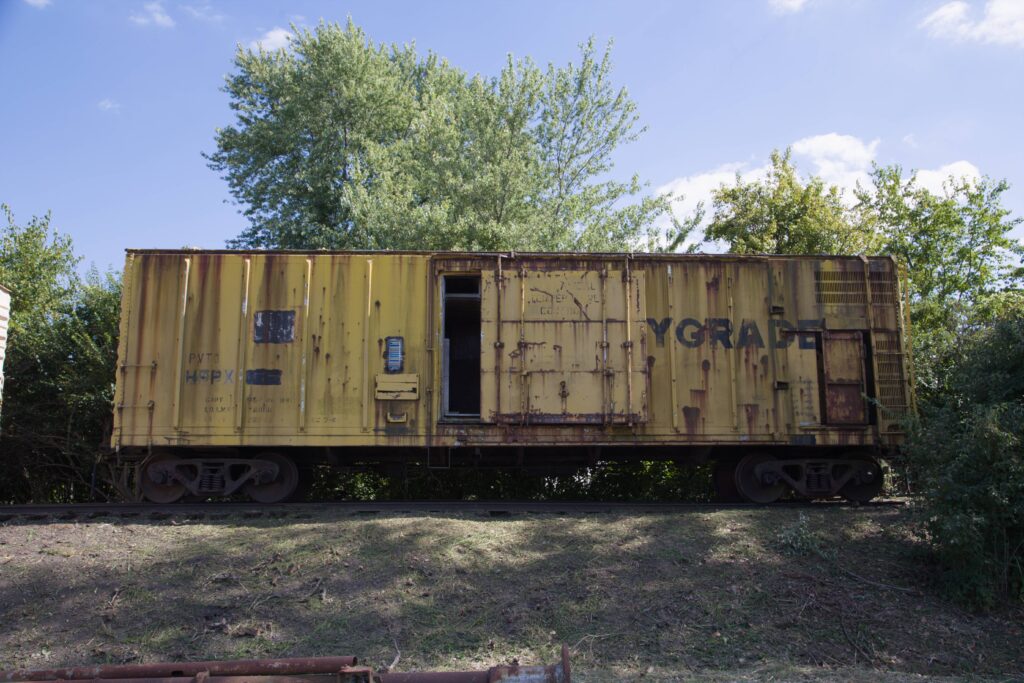
HFPX 125 (Hygrade Food Products), 1961
Builder: General American Transportation Corporation (GATX)
Type: Mechanical refrigerator car (reefer)
Original Use: Leased to Hygrade Food Products Corporation for transporting perishable goods, including raw meat, processed products, and ingredients
Build and Early Service
Hygrade Food Products Corporation was a prominent American meatpacking and processing company, founded in 1914 in Detroit, Michigan, by Samuel Slotkin with an initial investment of $15,000 and 12 employees. The company initially focused on meat provisions and expanded rapidly, merging with eight other companies in 1927 to form a larger corporation. Hygrade pioneered pre-packaged meats sold through delicatessens and emphasized processed, ready-to-eat products, which became a core part of its business.
In 1952, Hygrade acquired Kingan & Company, an Indianapolis-based meatpacker, making it the nation’s fourth-largest meatpacking firm at the time. This acquisition included Kingan’s facilities, which were the world’s largest pork-packing plant, spanning 26 acres, but the Indianapolis plant closed in 1966 due to rising costs and low profits. Hygrade also operated a plant in Storm Lake, Iowa, which closed in 1981, resulting in the loss of about 600 jobs and impacting the local community. The company’s headquarters and primary operations were in Detroit, but by the mid-20th century, it had a major processing plant in Livonia, Michigan (a suburb of Detroit), located at 38200 Plymouth Road. This Livonia facility was central to Hygrade’s production, including hot dogs, and operated until around 1995, when it closed.
Hygrade’s most famous contribution to American food culture came in 1957, when it won a competition to become the exclusive hot dog supplier for the Detroit Tigers at Briggs Stadium (later Tiger Stadium). To meet the demand, Hygrade developed a plumper, juicier frankfurter that “plumped when you cooked ’em,” branding it as Ball Park Franks. This product was initially created specifically for the ballpark and quickly became a hit with fans, evolving into a national brand. The Livonia plant was key to producing these franks, and Hygrade’s marketing, including endorsements by local personalities like weatherman Sonny Eliot, helped boost its popularity in Michigan.
To support its meatpacking operations, Hygrade leased a private fleet of railroad cars from GATX under the reporting mark HFPX for transporting perishable goods. These cars were primarily mechanical refrigerator cars, which used propane-fired refrigeration units to maintain cold temperatures. This technology, popularized in the 1950s and 1960s, revolutionized food transportation by allowing longer-distance shipping of fresh meat without spoilage. The HFPX 100-199 series, including car 125, were experimental conversions from Pacific Fruit Express (PFE) R-40-23 ice refrigerator cars to mechanical refrigeration. Built in 1961, these all-steel cars featured modern propane-fueled systems for reliable cooling.
Hygrade’s HFPX cars were typically used to move meat between plants, suppliers, and distribution points. For example:
- Raw meat and ingredients were sourced from major stockyards and packing centers, then shipped to processing facilities like the Livonia plant.
- Finished products, including hot dogs, were distributed to customers, including direct shipments to venues like Tiger Stadium.
While Hygrade did not have a documented plant in St. Louis, the city was home to the National Stock Yards—one of the largest meatpacking hubs in the U.S. during the mid-20th century. HFPX railcars transported raw meat or livestock products from St. Louis-area suppliers to Hygrade’s Livonia plant for processing into hot dogs, including those destined for Detroit Tigers games. Hygrade’s operations involved nationwide sourcing, and refrigerated railcars like the HFPX series were ideal for such perishable hauls, ensuring freshness over long distances.ed railcars like the HFPX series were ideal for such perishable hauls, ensuring freshness over long distances.
Service Life and Retirement
The HFPX refrigerator cars served Hygrade through the peak of its operations in the 1960s and 1970s. In 1982, Hygrade faced a major crisis with a product tampering scare involving razor blades found in hot dogs, leading to a voluntary recall in five states. The company recovered but was eventually acquired by Sara Lee Corporation in 1989. The Ball Park brand later passed to Tyson Foods, where it remains today.
After Hygrade’s acquisition and plant closures, many HFPX cars were retired, sold, or scrapped. The reporting mark HFPX was eliminated in October 1992.
Preservation and Current Ownership
The TLE&W acquired this HFPX reefer for static display, storage, or potential restoration as part of our collection—after Hygrade’s rail operations ended. Its history reflects the broader evolution of refrigerated rail transport, which enabled companies like Hygrade to expand nationally and innovate products like Ball Park Franks. The car can be visited using our interactive map in our outdoor collection.
Specifications
| Attribute | Details |
|---|---|
| Builder | General American Transportation Corporation (GATX) |
| Built | 8-1961 |
| Type | Mechanical refrigerator car (reefer); experimental conversion from ice bunker reefer |
| Class | R111 |
| Original Basis | Converted from Pacific Fruit Express (PFE) R-40-23 ice refrigerator car |
| Reporting Mark / Number | HFPX 125 (part of HFPX 100–199 series) |
| Lessee/Operator | Hygrade Food Products Corporation (leased from GATX) |
| Length | 40 feet |
| Construction | All-steel body |
| Refrigeration System | Propane-fired mechanical refrigeration |
| Capacity | 110,000 lbs (payload/load limit) |
| Load Limit | 155,000 lbs |
| Light Weight | Approximately 55,000 lbs |
| Features | Modern (for 1961) propane-fueled cooling system for reliable perishable transport without ice; designed for meat/processed food shipments (raw meat from stockyards to plants; finished products like hot dogs to distributors/venues) |
| Service History | Leased for Hygrade’s meatpacking operations (1960s–1970 peak); transported raw meat/ingredients (e.g., from National Stock Yards, St. Louis to Livonia, MI plant) and finished products (e.g., Ball Park Franks to customers/Tiger Stadium); supported nationwide fresh/perishable shipping |
| Later History | Hygrade acquired by Sara Lee Corp. (1989); HFPX reporting mark eliminated October 1992; many cars retired/sold/scrapped post-plant closures |
| Acquisition | Donated to Toledo, Lake Erie & Western Railway and Museum (TLE&W) around 1970. |
| Status | On outdoor static display at TLE&W facility, Grand Rapids, Ohio; preserved in collection for viewing (use interactive map on site) |
| Paint Scheme | Not specified (typical reefer scheme of era; may retain original or Hygrade-related markings) |
Collection Details
Preserved in the Toledo, Lake Erie & Western Railway and Museum outdoor collection