The Bluebird Is Coming Back!
Iconic Northwest Ohio Passenger Train Revival – Phase I In Progress (January 2026)
After pausing in 2009 for critical track work, our volunteer team is hard at work restoring the beloved Bluebird Passenger Train. We’re focusing on a starter segment between Patton Rd (MP 21.7) and Jeffers Rd (MP 23.3) near Grand Rapids — the essential first step to bring rides back along the scenic Maumee River.
What’s Happening Right Now in Phase I
- Replacing ~1,500 mainline ties & stabilizing culverts
- Clearing vegetation at crossings & building new Yawberg Rd platform/bridge
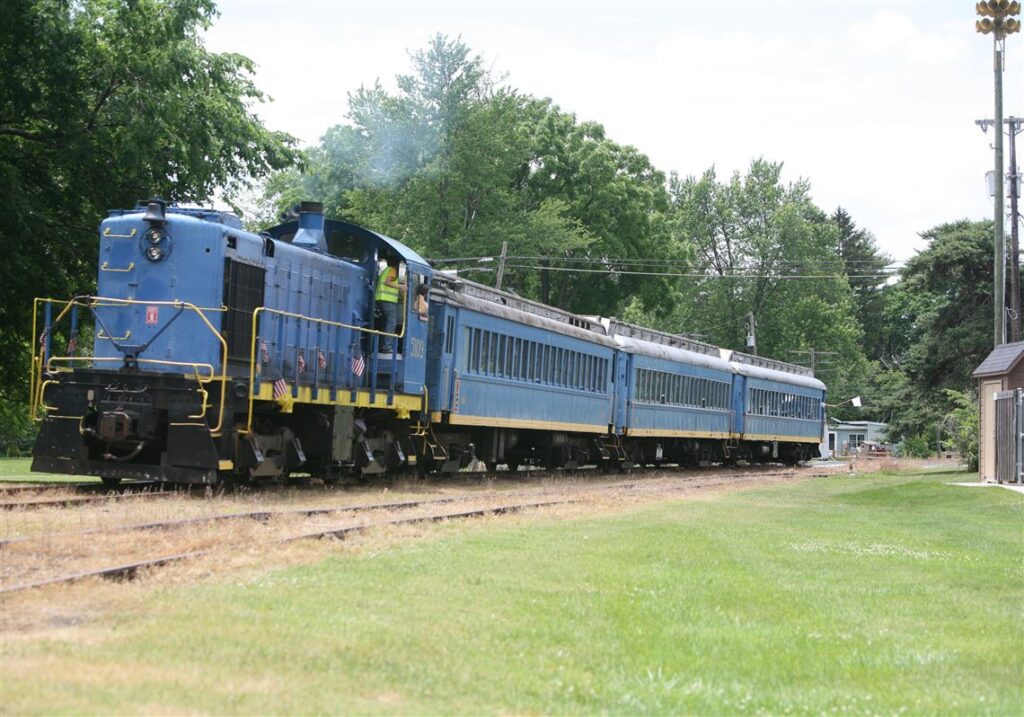
- Axle repair on 5109 (including lifting the Alco S4 locomotive), bodywork on at least one coach, painting/lettering NKP 475 caboose
- Updating rule book, training crews, notifying PUCO/schools/township
All future expansion depends on completing this starter segment successfully.
Watch our latest progress (2025–2026 workdays, lifting the 5109 Alco S4, track repairs, painting/lettering the NKP 475 caboose & more!):
Phase I Updates Playlist on YouTube →
For the full phased restoration plan (Phase II–IV details), visit our Bluebird Restoration Project page.
Early History of the Rail Line
The rail line that would later host the Bluebird Passenger Train was originally constructed in 1875 as part of the Toledo to St. Louis rail corridor, operated by the Toledo, St. Louis and Western Railroad (commonly known as the Clover Leaf Route). This line connected various points in Ohio and beyond. In 1913, following the destruction of the original Maumee River crossing during a major flood, a new 901-foot, six-span through truss bridge was built over the river in Grand Rapids, Ohio. The Clover Leaf was acquired by the New York, Chicago and St. Louis Railroad (Nickel Plate Road) in the early 20th century, and later merged into the Norfolk and Western Railway (N&W) in 1964.

Formation of the Toledo, Lake Erie & Western Railway
The Toledo, Lake Erie & Western Railway (TLE&W) was established in 1965 as a nonprofit organization dedicated to preserving northwest Ohio’s railroad heritage, and it was formally incorporated in 1969. Initially, operations were based in Toledo, but challenges with urban track usage led to a shift southward.
Launch and Early Operations of the Bluebird (1969–1970s)
The Bluebird Passenger Train, also known as the Bluebird Special, began service on June 1, 1969, as an excursion train operated by the volunteer-run TLE&W. It initially ran from Dorr Street and Secor Road in Toledo, using a rented steam locomotive and three borrowed cabooses. These were soon replaced by donated coaches from the Wabash Railroad, which were later swapped for lighter New York Central commuter coaches to increase seating capacity.
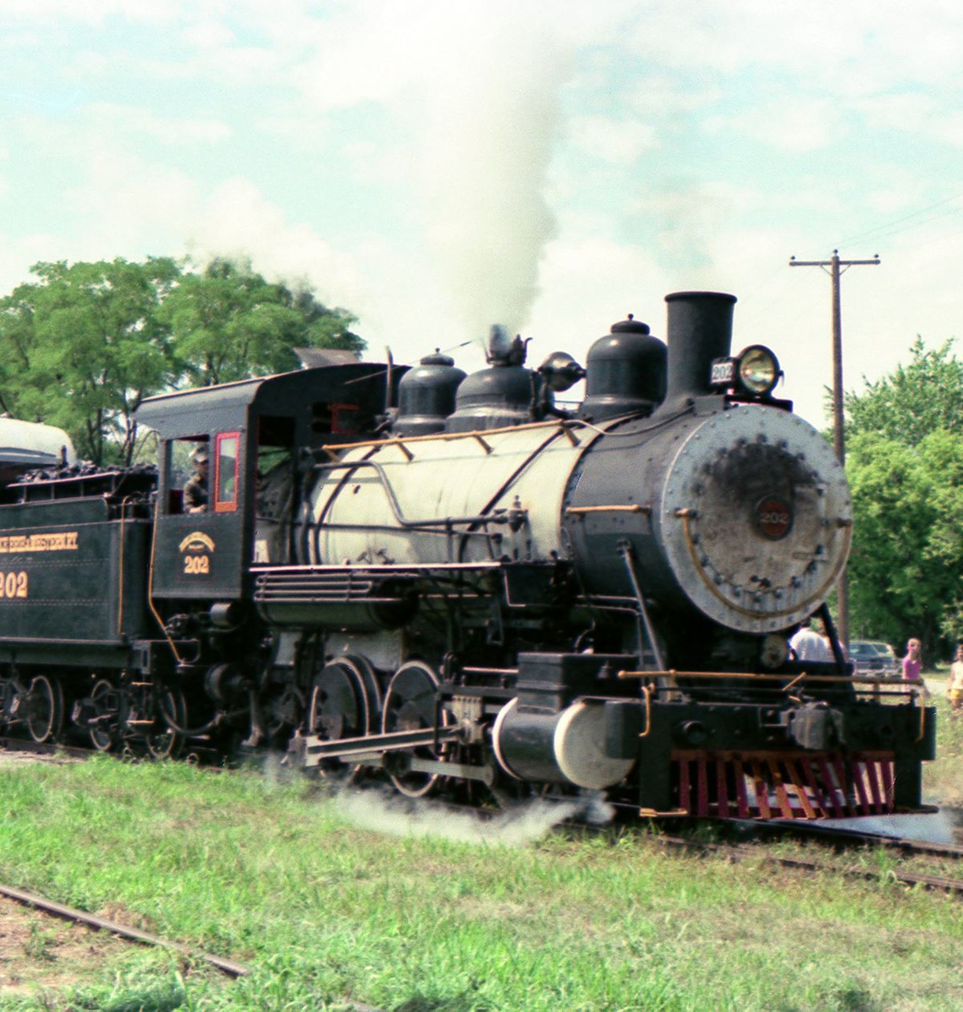
In 1973, the lease on the original steam engine (Chesapeake & Ohio #377) expired, prompting the acquisition of a donated Baldwin 0-6-0 switcher locomotive #202 (built in 1920 for Detroit Edison) from the Michigan Railroad Club. This engine was restored within 11 months and pulled its first train in 1974. TLE&W also obtained a 1941 Whitcomb 44-ton diesel switcher #1 from the Ann Arbor Railroad.
Due to operational issues in Toledo, including long backup moves across busy streets, the TLE&W relocated operations to the N&W’s trackage between Waterville and Grand Rapids, Ohio—a 10-mile stretch—after N&W ended through service on the line. The first run on this segment occurred in 1974, with Engine #202 hauling the Bluebird from Waterville to Grand Rapids. The train became a popular attraction in the 1970s, offering scenic rides along the Maumee River and preserving local rail history.
In 1976, when N&W petitioned to abandon the line south of Milepost 15 in Waterville, TLE&W purchased the segment from Milepost 15 to 25 (on the western edge of Grand Rapids) and secured trackage rights to Milepost 14 to continue using the Waterville depot. By 1978, N&W no longer maintained a full-time agent in Waterville.
1980s–1990s Operations
The Bluebird continued as a tourist excursion train, with steam operations using Engine #202 until 1982, when a Federal Railroad Administration (FRA) inspection required a major overhaul, shifting to diesel power thereafter. Photos from the late 1980s show the train, including #202, stopping at the Waterville depot during special runs. Service to or from Waterville reportedly ended in 1998, after which the Bluebird focused on shorter excursion runs between Waterville and Grand Rapids.
2000s: Revival and Shutdown
By 2003, the Bluebird was revived for excursion service between the villages, highlighting its role as a nostalgic attraction crossing the historic Maumee River bridge. Operations continued until 2009, when the train was shut down for essential track improvements.
2023: The Rails Awaken
Since 2009, dedicated volunteers with the Toledo, Lake Erie & Western Railway have been steadfast in their efforts to restore operations. While administrative changes within the TLE&W temporarily hindered momentum, those challenges are now in the past. We’re thrilled to move forward with fresh leadership, an enthusiastic board of trustees, and a structured, phased plan to rehabilitate the track, rolling stock, and locomotive. In 2025, we’re leveraging modern digital platforms to keep the public informed about our advancements. Be sure to check out the Phase 1 updates on our YouTube channel to stay up to date with our journey!