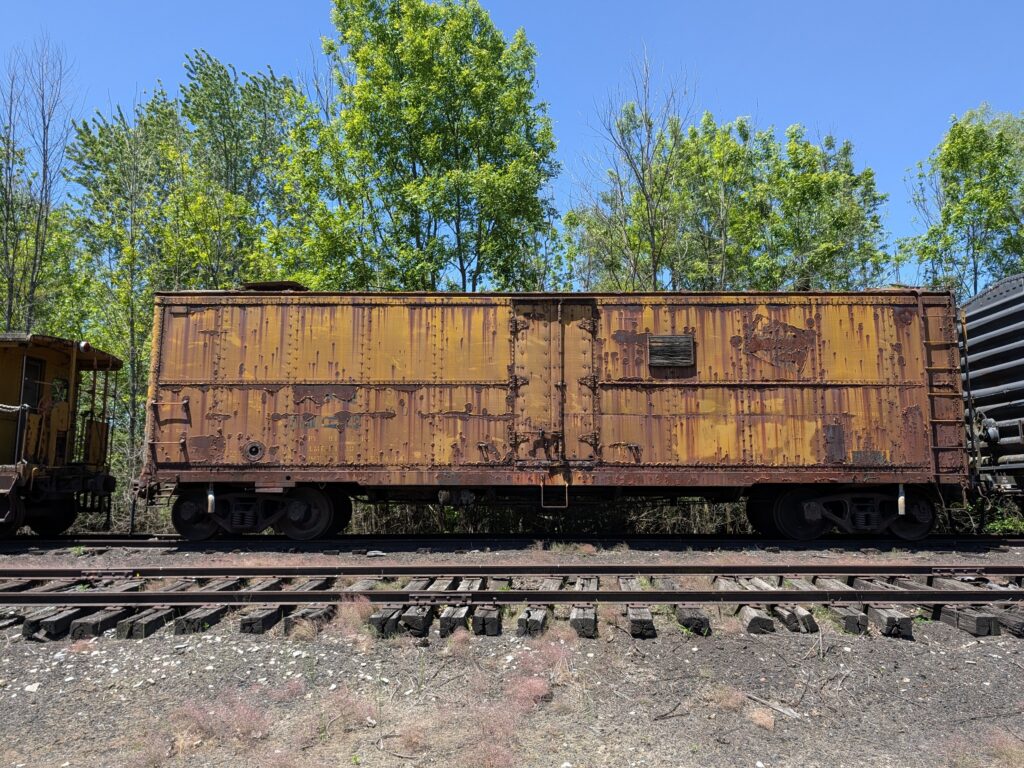
Builder: General American Transportation Corporation (GATC)
Type: 40-foot steel ice-bunker refrigerator car (produce/service reefer)
Reporting Marks: URTX (Union Refrigerator Transit Lines)
Car Number: 37087
Original Use: Transport of perishable commodities such as fresh produce, dairy, and other temperature-sensitive freight.
Built: Circa 1948–1950 (part of the postwar 37000-series)
Road Number Series: URTX 37000–37499 (Milwaukee Road-leased fleet)
Build and Early Service
This refrigerator car was constructed by General American Transportation Corporation during the postwar boom in rail transportation of perishables. It was part of a large fleet operated by the Union Refrigerator Transit Lines (URTX/URT), a private car company with strong ties to the Milwaukee Road (Chicago, Milwaukee, St. Paul & Pacific Railroad). Cars in this series were typically leased to or painted with the Milwaukee Road herald and operated extensively across the Midwest and beyond for perishable traffic.
The car features several notable engineering advancements for its era:
- Duryea Cushion Underframe: A shock-absorbing design that isolated the car body from impacts during switching and humping, protecting fragile loads like fruits and vegetables.
- Axle-Driven Fan System: An innovative mechanical cooling aid (often associated with Preco-style equipment) where a belt connected to one of the truck axles powered a fan/blower. A lever inside the car allowed crew members to engage or disengage the drive as needed. This circulated air over ice bunkers in the car’s ends while the train was in motion, improving temperature consistency without relying on external power. This was particularly valuable for produce service.
- Riveted steel construction, ice hatches on the roof, and insulation designed for ice-and-salt cooling.
These cars played a vital role in the pre-mechanical refrigeration era, helping move fresh goods from farms and packing houses to urban markets across the United States.
Service Life and Retirement
From the late 1940s through the 1960s–early 1970s, URTX cars like 37087 hauled perishables on the Milwaukee Road and in interchange service nationwide. As railroads transitioned to mechanical reefers in the 1960s and 1970s, many ice cars were retired. General American phased out the URTX fleet in the early 1970s.
Acquisition by Toledo, Lake Erie & Western Railway and Museum
This car was acquired by the Toledo, Lake Erie & Western Railway and Museum because of the historical significance of its refrigeration technology—a key example of mid-20th-century innovation in perishable freight transport.
By preserving URTX 37087, the museum highlights an important chapter in railroad history: the transition from basic ice-bunker cars to more sophisticated air-circulation systems that extended the reach and reliability of fresh food shipping before the widespread adoption of diesel-powered mechanical reefers. It stands as a tangible reminder of the engineering ingenuity that kept America’s food supply chain moving efficiently.
The car has been part of the museum’s collection for many years, displayed outdoors alongside other preserved freight equipment at the Grand Rapids, Ohio site. It is one of multiple refrigerator cars in the museum’s roster.
Specifications
| Specification | Value | Notes |
|---|---|---|
| Builder | General American (GATC) | Postwar steel reefer |
| Year Built | ~1948–1950 | Part of 37000-series |
| Car Number | URTX 37087 | Milwaukee Road-leased |
| Capacity | ~40-ton (typical for series) | Ice bunker design |
| Features | Duryea cushion underframe, axle-driven fan/blower with lever engagement, ice hatches | Enhanced air circulation for produce |
| Trucks | Barber S-2 (typical) | Common on GATC reefers |
| Length | ~40 feet | Standard for era |
| Construction | Riveted steel sides & ends | Insulated with ice bunkers |
Collection Details
Preserved in the Toledo, Lake Erie & Western Railway and Museum outdoor collection
Accession: N/A | Acquired: N/A | Status: Closed to the Public